
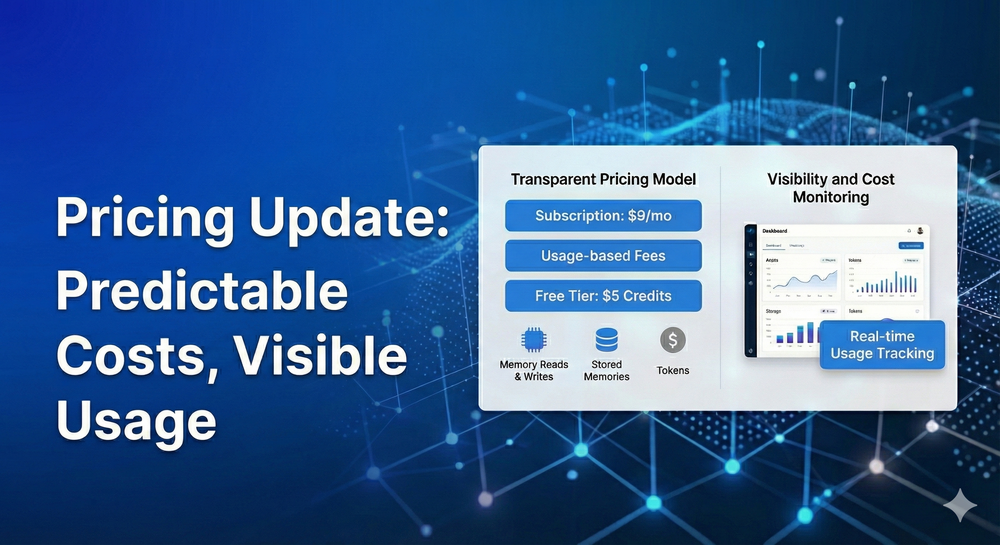
Toronto, Canada — Backboard.io today announced a major pricing update designed to address one of the fastest-growing challenges in AI adoption: unpredictable costs, fragmented infrastructure, and a lack of control over how compute is consumed in production systems.
As AI systems move from experimentation to mission-critical software, teams are discovering that token-based pricing alone fails to reflect how real, stateful systems behave in production. Costs fluctuate based on retries, prompt growth, orchestration logic, routing decisions, and context expansion—leaving developers unable to forecast spend and enterprises struggling to govern it.
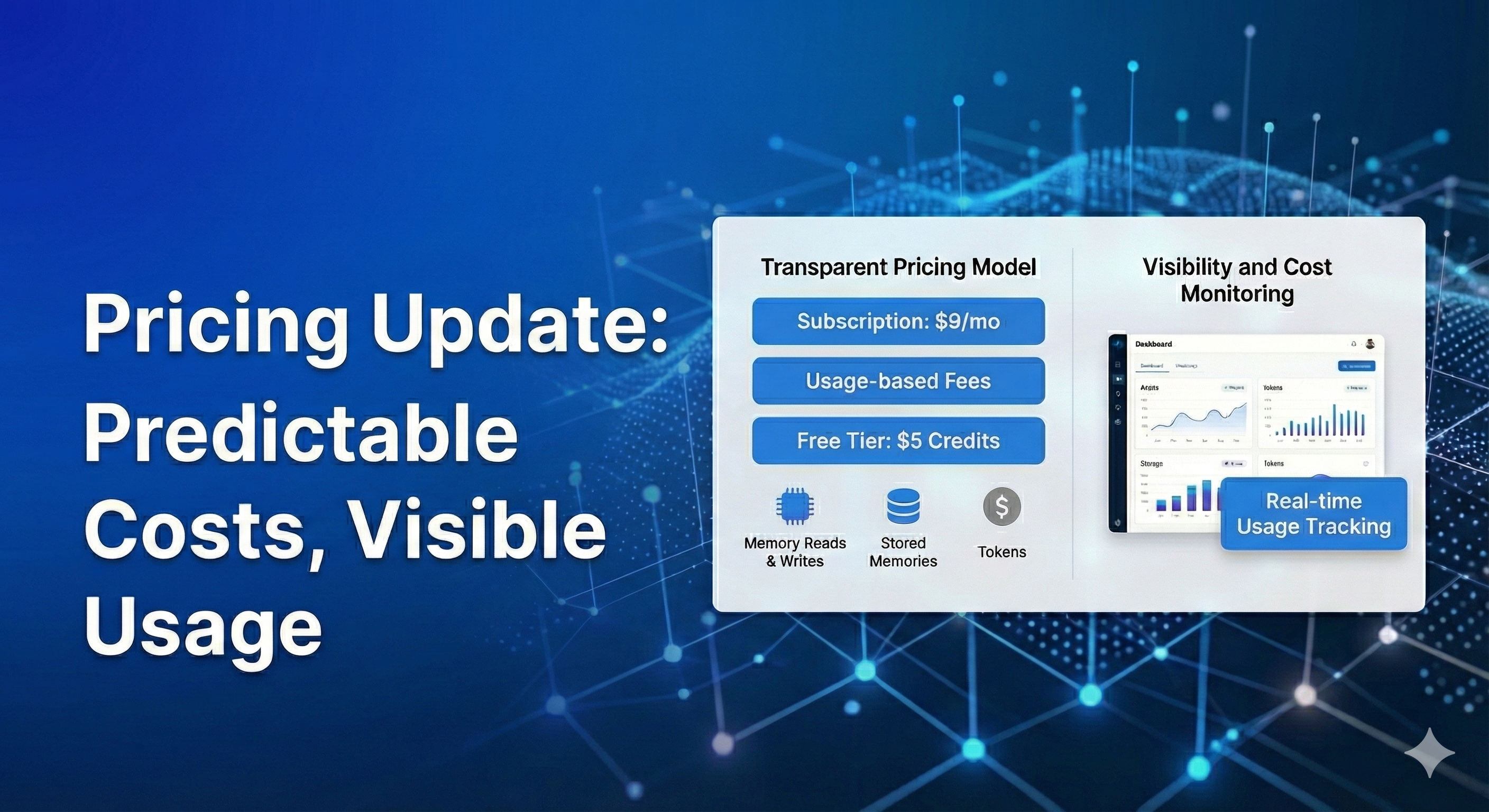
Backboard’s updated pricing model introduces predictable entry costs, usage-level transparency, and fine-grained control over compute allocation, all delivered through a single API.
• Limited control over compute allocation, with low-value tasks often routed to expensive reasoning models
As systems scale, these issues compound—turning AI spend into an operational risk rather than a controllable engineering decision.
This allows teams to test real workflows, state, and routing logic in production-like conditions before committing to a paid plan.
Developers can start with only what they need—memory, orchestration, retrieval, model routing, or execution management—and integrate Backboard alongside existing infrastructure. Components can be added incrementally as systems evolve, reducing adoption risk and avoiding forced stack replacement.
This modularity makes Backboard suitable for both greenfield projects and existing production systems.
Not every AI task requires an expensive reasoning model. With Backboard, deterministic or low-compute tasks can be routed to lower-cost or open-source models, while premium reasoning models are reserved for work that genuinely requires them. All routing, memory, orchestration, and execution is managed under a single API, allowing teams to intentionally allocate AI spend instead of passively absorbing it.
Backboard does not arbitrarily mark up token pricing. As platform efficiencies improve, savings are passed directly to users rather than hidden behind new tiers.
All usage and charges are visible in real time. Users can see how much they have used, what they are being charged for, and how costs break down across memory, storage, orchestration, and tokens—without support tickets or manual reporting.
Teams can replace multiple layers of their AI stack over time or use Backboard selectively where it delivers the most value.
For startups, Backboard offers a low-friction entry point, cost discipline from day one, and the ability to scale without re-architecting later. For enterprises, it enables forecastable AI spend, governance, and flexibility across model providers—without lock-in.
As AI adoption matures, value is shifting away from raw model access toward control, efficiency, and system behavior. Backboard is designed to operate at that layer: the intelligence control plane above model providers.
Backboard.io is a developer-first AI infrastructure platform built to serve as the persistent state and control layer for large language models. Ranked #1 on the LoCoMo benchmark, Backboard enables memory-native AI systems that move beyond short-term conversational context to retain high-fidelity, long-term state for complex SaaS tools and autonomous agents.
The platform supports multi-model orchestration across more than 2,000 LLMs, providing a portable memory and execution layer that works across providers rather than locking teams into a single vendor. By combining persistent memory, context management, and stateful orchestration, Backboard allows teams to deploy production-ready AI systems in minutes. The company is focused on solving AI’s statelessness problem: giving systems the ability to remember, retrieve, and build on prior interactions to support sophisticated, multi-step workflows.